Widening Study of a 45-Meter Tuna Fishing Vessel Based on Multi-Objective Optimization
DOI:
https://doi.org/10.25043/19098642.272Keywords:
multi-objective optimization, ship widening, fishing vessel stability, second generation stability criteria (SGSC), GRG method, international maritime organization (IMO)Abstract
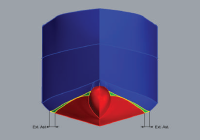
Stability issues in fishing vessels represent a significant risk to maritime safety, despite advances in stability regulations by the International Maritime Organization (IMO). This paper presents a multi-objective optimization study focused on the widening of a 45.1-meter tuna fishing vessel to improve stability by increasing its beam. The optimization was developed based on the IMO’s Second Generation Stability Criteria (SGSC), evaluating the vessel’s critical failure modes. The Non-Linear Generalized Reduced Gradient (GRG) method method was applied to obtain a balanced solution that improves stability and increases cargo capacity while maintaining operational safety. The vessel's improved performance was validated under operational conditions, demonstrating the feasibility of the proposed modifications.Downloads
References
Diario El Comercio, «Dos muertos y tres desparecidos en el naufragio del atunero Tuna I,» Abril 2012.
International Maritime Organization, «GUIDELINES FOR THE APPROVAL OF STABILITY INSTRUMENTS,» 2007.
IMO, «INTERIM GUIDELINES ON THE SECOND GENERATION INTACT STABILITY CRITERIA,» 2020.
Diario El UnIverso, «Siete desaparecidos al naufragar barco pesquero en las Galápagos,» 2012.
N. PETACCO y P. GUALEN, «IMO Second Generation Intact Stability Criteria:General Overview and Focus on Operational Measures,» Marine Science and Engineering, p. 20, 2020. https://doi.org/10.3390/jmse8070494
IMO SDC 7, «Draft consolidated explanatory notes of interm guidelines of second generation intact stability criteria,» Noviembre 2019. [En línea]. Available: https://www.linkedin.com/pulse/nautical-analysis-maib-0220-cma-cgm-gwashington-loss-gunter-sch%C3%BCtze/.
Published
Issue
Section
License
Copyright (c) 2025 Cotecmar

This work is licensed under a Creative Commons Attribution 4.0 International License.
The authors who publish in this Journal certify that:
- The work submitted for publication in The Ship Science and Technology (Cartagena) journal, was written by the author, given that its content is the product of his/her direct intellectual contribution.
- All data and references to material already published are duly identified with their respective credits and are included in the bibliographic notes and quotations highlighted as such.
- All materials submitted for publication are completely free of copyrights; consequently, the author accepts responsibility for any lawsuit or claim related with Intellectual Property Rights thereof, Exonerating of responsibility to The Science and Technology for the Development of Naval, Maritime, and Riverine Industry Corporation, COTECMAR.
- In the event that the article is chosen for publication by The Ship Science and Technology journal, the author state that he/she totally transfers reproduction rights of such to The Science and Technology for the Development of Naval, Maritime, and Riverine Industry Corporation, COTECMAR.
- The authors retain the copyright and transfer to COTECMAR the right of publication and reproduction of the work which will be simultaneously subject to the Creative Commons Attribution License (CC -BY) , which allows the license to copy, distribute, display and represent the work and to make derivative works as long as it recognizes and cites the work in the manner specified by the author or licensor.
- For more information about the Creative Commons Attribution License (CC -BY) and his use and scope, please visit the following web page https://creativecommons.org/licenses/by-sa/4.0/legalcode