Design of a charger/discharger for hybrid energy storage stations, intended for electric vessels used in river transportation
DOI:
https://doi.org/10.25043/19098642.270Keywords:
battery charger-discharger, boost converter, second life battery, hybrid energy storage systemAbstract
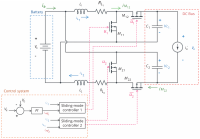
Electric motor-powered river vessels are increasingly common in areas that prioritize sustainability and environmental protection. The use of electric motors enhances energy efficiency, reduces emissions, noise levels, operational costs, and maintenance frequency. These motors are powered by batteries previously charged at a charging station, which can be equipped with battery banks composed of new batteries, second-life batteries (SLBs), or hybrid systems integrating both types of batteries. The use of SLBs, which still retain a significant portion of their capacity after their first life, optimizes resources, reduces costs and waste, and extends their service life. Due to the heterogeneous degradation of cells in SLBs and the progressive reduction of capacity with each charge/discharge cycle, it is necessary to implement a specific control and monitoring strategy for these cycles to optimize their lifespan. This work describes the design of the power and control systems for a battery charger/discharger based on a Boost converter. The system employs a current controller that combines sliding-mode current control with a proportional-integral controller to ensure overall stability and limit current derivatives, thereby preventing accelerated battery degradation. This modular plug-and-play device enables the optimal connection and charging of both new and second-life batteries. Simulation results confirmed the validity of the proposed designs by meeting the established requirements in charge, discharge, and standby scenarios.Downloads
References
S. KARIMI, M. ZADEH and J. A. SUUL, "Shore Charging for Plug-In Battery-Powered Ships: Power System Architecture, infrastructure, and Control," IEEE Electrification Magazine, vol. 8, no. 3, pp. 47-61, 2020. https://doi.org/10.1109/MELE.2020.3005699
N. MUKHERJEE and D. STRICKLAND, "Analysis and comparative study of different converter modes in modular second-life hybrid battery energy storage systems," IEEE J. Emerg. Sel. Topics Power Electron, vol. 4, no. 547-563, p. 2, Jun, 2016. https://doi.org/10.1109/JESTPE.2015.2460334
X. GU et al., "Challenges and opportunities for second-life batteries: Key technologies and economy," Renewable and Sustainable Energy Reviews, no. 192, p. 114191, 2024. https://doi.org/10.1016/j.rser.2023.114191
F. MANDRILE, M. PASTORELLI, S. MUSUMECI, I. A. URKIRI and A. REMIREZ, "Second Life Management From Battery Storage System of Electric Waterborne Transport Applications: Perspectives and Solutions," IEEE Access, vol. 11, pp. 35122 35139, 2023. https://doi.org/10.1109/ACCESS.2023.3265168
QURAAN M, ABU-KHAIZARAN M, SA'ED J, HASHLAMOUN W, TRICOLI P., "Design and control of battery charger for electric vehicles using modular multilevel converters.," IET Power Electron, vol. 14, pp. 140-157, 2021. https://doi.org/10.1049/pel2.12018
M. SAFAYATULLAH, M. T. ELRAIS, S. GHOSH, R. REZAII and I. BATARSEH, "A Comprehensive Review of Power Converter Topologies and Control Methods for Electric Vehicle Fast Charging Applications," IEEE Access, vol. 10, pp. 40753-40793, 2022. https://doi.org/10.1109/ACCESS.2022.3166935
O. LÓPEZ-SANTOS et al., "Robust Control for a Battery Charger Using a Quadratic Buck Converter," IEEE Access, vol. 12, pp. 125480-125492, 2024. https://doi.org/10.1109/ACCESS.2024.3454362
H. in SIRA-RAMIREZ, "Sliding Motions Bilinear Switched Networks," IEEE Transactions on Circuits and Systems, vol. 34, no. 8, pp. 919-933, 1987. https://doi.org/10.1109/TCS.1987.1086242
POWERSIM INC., PSIM, ver. 12.0, Rockville, MD, USA., 2024.
The MathWorks, Inc., MATLAB, "SISOTool, Natick, MA, USA., 2024.
Published
Issue
Section
License
Copyright (c) 2025 Cotecmar

This work is licensed under a Creative Commons Attribution 4.0 International License.
The authors who publish in this Journal certify that:
- The work submitted for publication in The Ship Science and Technology (Cartagena) journal, was written by the author, given that its content is the product of his/her direct intellectual contribution.
- All data and references to material already published are duly identified with their respective credits and are included in the bibliographic notes and quotations highlighted as such.
- All materials submitted for publication are completely free of copyrights; consequently, the author accepts responsibility for any lawsuit or claim related with Intellectual Property Rights thereof, Exonerating of responsibility to The Science and Technology for the Development of Naval, Maritime, and Riverine Industry Corporation, COTECMAR.
- In the event that the article is chosen for publication by The Ship Science and Technology journal, the author state that he/she totally transfers reproduction rights of such to The Science and Technology for the Development of Naval, Maritime, and Riverine Industry Corporation, COTECMAR.
- The authors retain the copyright and transfer to COTECMAR the right of publication and reproduction of the work which will be simultaneously subject to the Creative Commons Attribution License (CC -BY) , which allows the license to copy, distribute, display and represent the work and to make derivative works as long as it recognizes and cites the work in the manner specified by the author or licensor.
- For more information about the Creative Commons Attribution License (CC -BY) and his use and scope, please visit the following web page https://creativecommons.org/licenses/by-sa/4.0/legalcode